
Revolutionary Fight for Freedom: FXBG’s Black Sailors
This post incorporates text from Clint Schemmer’s February 2026 article in the Front Porch Magazine (“FXBG Storefronts Tell of Revolutionary Veterans”) with additional writing and research from HFFI Preservationist, Danae Peckler.
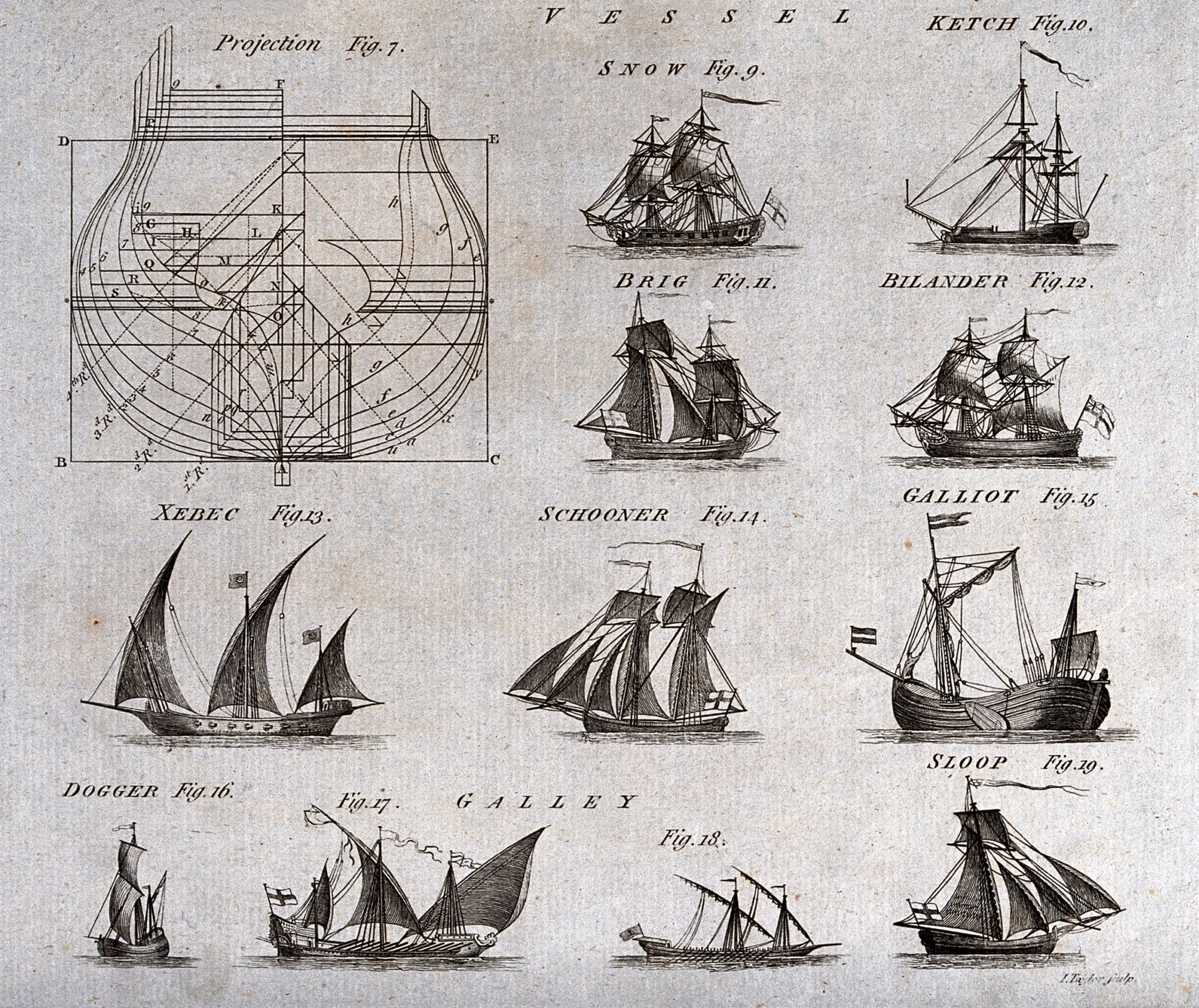
Shipbuilding diagram. Engraving by J. Taylor (1806).
In the American Revolution, African Americans fought on both sides — about 9,000 for the patriot cause and about 20,000 for the British cause, which promised freedom to enslaved people.
Dozens of those Black patriots came from the Fredericksburg area. Both free and enslaved Black men served in the local militia as well as State and Continental lines. As the local economy bent towards the shipping industry, many of those men enlisted in Virginia’s Navy, working as pilots, gunners, seamen, and cooks. “These young men faithfully served the patriot cause, typically surrounded by other family members, family friends, and neighbors,” Tulane University historian Ashley Schmidt writes of these soldiers and seamen. “Integrated units throughout the South meant that these young black men wielded muskets, were injured, taken prisoner, and died next to white soldiers.”
Virginia did not legally support the use of enslaved Blacks as substitutes for their White masters, but the practice was generally tolerated across the state. Lewis Hinton was a Black man who enlisted in Fredericksburg in the spring of 1777 as a substitute for “his master” William Hinton (excerpt from Lewis Hinton’s Revolutionary War pension application below).
I Lewis Hinton a resident of Lancaster County in the state of Virginia, do hereby certify and declare, that
I entered the service in the Va navy in the revolutionary war and served as follows viz – Not long after
the war commenced, William Hinton at that time my master, enlisted in the service for three years, to
serve in the navy of Virginia, and not long after his enlistment, the ship Dragon was fitted out at
Fredsburg [Fredericksburg] on which the sd Wm Hinton entered the service. After my master had been in
service about one year, his health became so bad, that he got released from his enlistment, by substituting
me in his place, and I was taken as his substitute, provided, I would enlist for the war, which I did, my
master consenting. It was to the best of my recollection in the spring of 1777 that I entered service on
board the Dragon, then lying at the Brick house up York river [in New Kent County S of present West
Point], commanded by captain Callender, Lt Jno Hamilton, Lt Fields [sic: Theophilus Field R60],
midshipmen Frs Webb, Alvin Wilson, Joshua McWilliams, Sailing master Wooling Smith [Woolen
Smith]. Gunner’s mate Jno Nutall, Iveson Nutall gunner. Immediately after entering on board, we started
on a cruize and were six weeks at sea, & returned to Hampton roads, then we took a cruize of eight
weeks, & returned to Mobjack bay. On another cruize at sea, we had an engagement with the schooner
Lord Howe, but she outsailed us & got away. After that we took two schooners loaded with flour near
Cape Henry, which the enemy had taken from our people. Towards the close of the war the Dragon went
up to the Navy Yard on Chickahominy river, where we left the ship. I remained some time at the navy
yard, and was then discharged & returned home to Lancaster County, where I have lived to the present
time. (Ambrose Lewis pension application: transcribed and annotated by C. Leon Harris. Revised 16 Nov 2013.)
It was not until the end of the war that the Virginia Legislature passed an act in October 1783 granting emancipation to the enslaved who served the American cause as some of their former masters were trying to reclaim them. Eventually, all of the 13 colonies except Georgia and South Carolina allowed enslaved people to enlist. Founding father Alexander Hamilton judged that “an essential part of the plan is to give them their freedom with their muskets.”
Another Black man who served aboard the the Dragon, a warship built at Mannsfield plantation by local shipping merchant, Fielding Lewis, was Ambrose Lewis (1760-1833). Ambrose was a 17-year-old resident of Spotsylvania County and a free Black man (with possible indigenous heritage) when he enlisted at Fredericksburg in the newly formed Virginia Navy in 1777. Serving nearly three years on the Dragon, Ambrose Lewis fought the British in one or more sea battles.
Completing his naval service, he enlisted in the 2nd Virginia Regiment in 1780. Under General Gates in South Carolina, he fought in the Battle of Camden, where he was bayoneted five times and captured by the British. Lewis was imprisoned in Charleston until the war’s end. In peacetime, Lewis returned to live in Fredericksburg and worked as a drayman, driving a flat-bed wagon (called a “dray”) pulled by horses or mules to transport all kinds of goods, in the last decades of the 18th century.
Ambrose Lewis’ wartime wounds had a lasting impact on his life and left him physically unable to work for long periods of time; as such, he received a small annual pension from the state of Virginia as early as 1788. (Check out Ambrose Lewis’ Revolutionary War state pension records from the Library of Virginia here. A transcription of Lewis’ federal pension records is also online here.)
Another Black seaman who served aboard the Dragon, William Jones, also worked as a drayman in Fredericksburg after the war. In the early 1800s, Jones purchased property on lower Charles Street in the same block where Ambrose Lewis resided.
As a shipping merchant, former supplier of the British army during the Seven Years’ War, and brother-in-law of George Washington, Fielding Lewis was early to embrace the rebellion and invested in the conversion of his cargo ships for military use and the construction of new boats to take on the British Navy. His fleet included the Dragon, Defiance, Hornet, Adventure, Rappahannock, and Patsey. Lewis sent his ships to harass the British and defend Virginians on Tidewater rivers and the Bay. All told, Virginia’s infant navy included about 40 vessels charged with guarding the state’s coast against enemy invasion. The Dragon, a three-masted schooner with 22 cannon and patrolled the Rappahannock River, the Chesapeake Bay, and Virginia’s Eastern Shore, is said to have hosted more than ten Black seamen in Virginia’s Navy during wartime.
Another former sailor and Revolutionary War veteran, John DeBaptiste, recently inspired a downtown Fredericksburg walking tour led by Dr. Gaila Sims, former curator at the Fredericksburg Area Museum. Born in 1740 on the Caribbean Island of St. Kitts, it is unclear how DeBaptiste came to serve on the Dragon, or if he was a free man or enslaved in the region prior to the war. For 25 years or more after the Revolution, he held the exclusive right to operate the Rappahannock River ferry that linked Fredericksburg with Falmouth, which was a fairly lucrative enterprise.
DeBaptiste owned Rappahannock River frontage on what’s now Canal Street, operating what became known as French John’s Wharf. A wayside panel at Canal and Sophia streets marks the spot. John died in 1804; he rests in the cemetery behind Union Church in Falmouth, where one can admire his handsome gravestone.
