
The Lewis & Dick families’ Revolutionary Legacies
This information is presented online as part of HFFI’s support for the Our Hearts Sparkle competition in downtown Fredericksburg, driven by Daughters of the American Revolution local chapters, the Sons of the American Revolution’s Colonel Fielding Lewis Chapter, the Fredericksburg Regional Genealogy Society, and the Central Rappahannock Regional Library (CRRL). The Lewis Store windows focus on the revolutionary legacies of two early Fredericksburg residents: Fielding Lewis and Charles Dick.
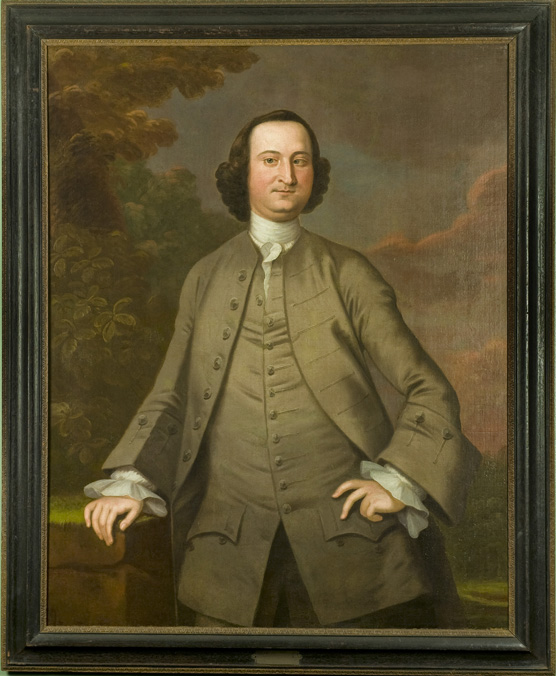
Painting of Fielding Lewis, Sr. by John Wollaston, ca. 1750s (George Washington Foundation).
Constructed in 1749, the brick building commonly referred to as the Lewis Store at 1200 Caroline Street has a lot of stories to tell. One of few surviving structures from 18th-century Fredericksburg, this bustling retail shop and workplace for Fielding Lewis, George Washington’s brother-in-law, is located at the northern edge of the city grid between Lewis’ house and the Rappahannock River. Fielding Lewis’ father, John, traveled to Fredericksburg as early as 1742 and later established an outpost for shipping business at the north end of town. As the owner of a robust shipping business, John Lewis became acquainted with enterprising residents in Fredericksburg like Charles Dick. Dick operated his own commercial store in town as early as 1743. Historian Paula Felder supposed that John Lewis favored Dick’s approach to business and may have encouraged him to serve as a mentor to Fielding Lewis.
For the next 40 years, Charles Dick (1715–1783) and Fielding Lewis (1725–1781/82) were faithful friends, business partners, neighbors, and leaders active in local government and civic life. The pair gained state and national attention during the American Revolution, working together to establish and maintain the Fredericksburg Gunnery.
In 1750, Dick purchased two lots on the south side of Lewis Street to become Fielding Lewis’ immediate neighbor, building a home, several outbuildings, and a store. Each owned land stretching from Caroline to Princess Anne streets. Lewis’ first house, completed in 1746, was two stories tall and constructed of brick. Dick’s frame house was also two stories and positioned atop the natural bluff along Princess Anne Street. (While Lewis’ house was destroyed by the 1807 fire, a portion of Charles Dick’s survives in the dwelling at 1107 Princess Anne Street). Both dwellings were designed to face east toward the river. To access their front doors, guests would have ascended a series of terraced walls leading west from Caroline Street (segments of terracing remain visible on both properties today). This path of progression traversed a designed landscape through a large lot and urban complex that served as a clear sign of their wealth and social status.
Dick was an arms and potash manufacturer who came to live in Spotsylvania County about the time when he first met John Lewis on a visit to the Fredericksburg Courthouse. Late in the 1750s and early 1760s, Dick participated in the large-scale production of potash for shipment to England, where it was widely used in the manufacture of glass, soft soap, drugs, dyes, and saltpeter. Fielding Lewis quickly gained prominence in local politics and business, serving on the vestry of St. George’s, in the Virginia House of Burgesses from 1760 to 1770, and as justice of peace for Spotsylvania County, in addition to prospering as a merchant, ship owner, and land developer.
During the French and Indian War, Lewis and Dick supplied the Virginia militia on the frontier and were fairly familiar with the goods such soldiers required. In 1775, Lewis partnered with Charles Dick to begin operating a gun manufactory in Fredericksburg. Details regarding its development and production are recorded in several letters between Lewis, Dick, and Virginia officials at the time (more from the library’s website). At the same time, Lewis pledged resources to supporting the patriot cause by transporting supplies, providing provisions for troops from his store, and buying and commissioning ships to be built to defend the Rappahannock River (the start of the Virginia Navy). Learn more about Fielding Lewis’ support for the defense of Virginia’s coastline here.
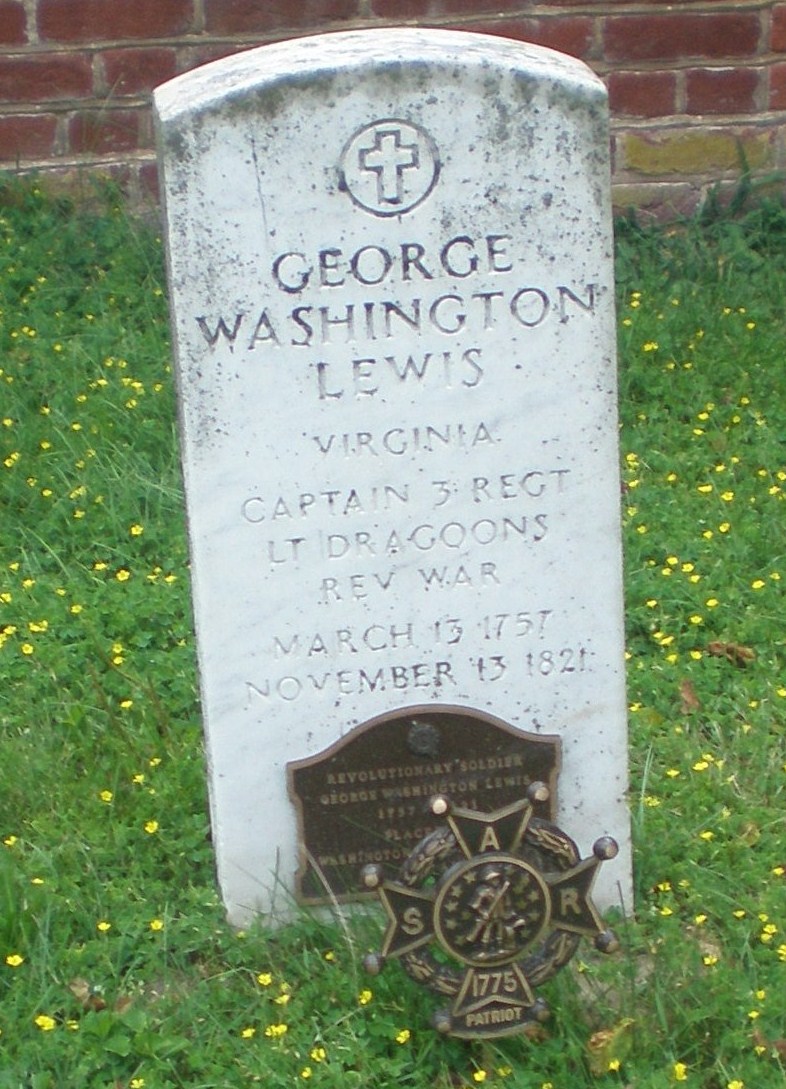
Image of George Washington Lewis headstone, Willis cemetery, Fredericksburg.
Lewis and Dick ultimately pledged and lost their fortunes in service of the American Revolution. While neither fought on the battlefield, their sons readily served the cause. Fielding and Betty’s first son, George Washington Lewis (1752–1821), was about 18 when war broke out. General Washington appointed him to serve as second in command of his personal Guard. George Lewis had attained the rank of Captain by the end of 1776. When Washington learned of General Hugh Mercer’s wounding at Princeton, he sent Captain Lewis to his side along with Dr. Benjamin Rush. A doctor himself, Mercer knew his wounds were fatal, but lived for another nine days and died on January 12, 1777 in the arms of George Lewis (Maloy, Hugh Mercer’s Last Companion, 2018). In 1777, Captain George Lewis and his troop of horsemen were assigned to the 3rd Regiment of Continental Light Dragoons. Lewis was often detached from the 3rd Regiment “on command” to support Washington’s Life Guards over the course of the next two years before he resigned from military service in the spring of 1779.
Charles Dick’s only son, Alexander Dick (1753–1785) became captain of a company of Virginia marines in February 1776, and in December of that year, the Virginia Navy Board ordered him and his company aboard the privateer brig Mosquito (also spelled Mosquetto). After the ship’s capture by H.M.S. Ariadne off Barbados in June 1777, Dick was convicted of piracy and committed to Forton prison in Portsmouth, England. General Washington penned a letter to “The Board of War” on January 2–3, 1778, that began with an admonishment of the British authorities for their “cruel and unjustifiable treatment of Captain Dick and other imprisoned shipmen. George Wythe and Archibald Cary wrote a letter on behalf of the Virginia General Assembly ten days later, noting similar concerns for Alexander Dick and his fellow prisoners: “when their friends heard last from them [they] were confined close prisoners in Gosport or some other goal, not only destitute of friends, wanting necessaries, suffering grievous hardships, and otherwise cruelly treated, but threatened with a prosecution for treason under the execrable act of parliament made not long since” (Dixon and Hunter’s Virginia Gazette [Williamsburg], 27 Nov. 1778). In August 1778, an American lieutenant from The Sturdy Beggar named Benjamin Chew, who had escaped Forton prison, wrote a letter to Benjamin Franklin in Paris asking for his help in freeing Dick. By May 1779, Alexander Dick was dining with John Adams among others in France. Adams later spoke of his “good family and handsome fortune in Virginia” (Butterfield, Adams Diary, II, 370–1, 379). After Dick returned to America, he later served as a major in the Virginia State Garrison Regiment and with Col. Charles Dabney’s Virginia State Legion before he retired from the military in January 1783.