Latest News & Preservation Views: Spring-Summer 2026
1. Stand with HFFI against demolition in our historic district – please join us in Fredericksburg Circuit Court (701 Princess Anne Street) on September 30th at 11 AM!
This is the most important thing HFFI and Fredericksburg residents can actually do to protect our historic district and help prevent the needless demolition of our historic buildings. Learn more from HFFI President, David James, on why “standing” matters here,
2. Reviving the Renwick – City leaders approve of limited public use and ownership of the Renwick Courthouse at June 23, 2026 work session, falling short of Renwick Working Group goals and 2024 Action Plan items.
HFFI asked the current City Council to support the historic significance of the Courthouse and acknowledge its quintessential value to Fredericksburg residents as a symbol of local government again this past May. We also provided comments on the draft Public-Private Education Act agreement seeking potential developers for the property that you can read here.
3. Mayfield will be the City’s first National Register-listed Historic District in more than 20 years! Will the City’s support for nominating historic neighborhoods and important places beyond the Old & Historic District stop there?
The oldest section of the Mayfield neighborhood is being nominated for listing in the Register as part of a cost-share survey using City and State funding–a process that is expected to be complete in early 2027. While the ARB and members of the public have yet to see a copy of the nomination report, City staff says a final draft is currently under DHR review.
HFFI hopes the City and our ARB will advocate for greater identification and survey work to extend existing financial incentives for preservation to the older, charming neighborhoods surrounding the downtown core. These areas are most vulnerable to demolition for newer, bigger, and more expensive housing.
The recent loss of several historic houses in Fredericksburg’s “Extended Historic District”–an area that includes several older working-class neighborhoods is truly regrettable (RIP 604 Liberty, 615 Lafayette, 805 Marye, etc.). From 2006 until 2010, the City funded a cost-share study that identified this “extended” district–an effort that continues to support its National Register- eligibility today! The neighborhoods within this extended area are frequently documented by UMW Preservation students. Last year, HFFI submitted documentation approved by the DHR’s State Review Board – finding the College Terrace neighborhood to be a potentially historic.
Some financial incentives are available to help offset the costs of repairing and rehabilitating some City’s wonderful old buildings. Several private property owners downtown are making use of state and federal Historic Tax Credits–a benefit reserved for properties listed in the National Register of Historic Places. Historic Tax Credits can provide a 25-45% dollar-for-dollar match on qualified expenses to repair and rehabilitate historic places and have a significant impact on the local economy–investing more in skilled laborers, sustainable materials, and our community’s cultural vibrancy than new construction.
We will continue to lobby for the expansion of property owner’s access to several financial preservation tools and incentives in and out of the downtown district so individual homeowners can reap the benefits of Historic Tax Credits as well as investors.
Perhaps City Council’s recent approval of a special 10-year tax exemption, an estimated $4.1 million discount, to support the rehabilitation of the Old Mary Washington Hospital building into housing might reflect a greater political will to expand the City’s rehabilitation tax abatement program as well?
HFFI will again promote our recommendations for updating the existing rehabilitation program, discussed at length in the City’s June 2023 Preservation Incentives and Blight/Demolition Prevention study, at the 4th Annual Affordable Housing Summit in October – if you’re planning to attend, please stop by our table & say hello!
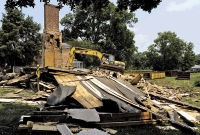
The remnants of an 18th century home at 1407 Caroline Street on Saturday afternoon, June 11, 2011 (Robert A. Martin/The Free Lance-Star).
4. What the Architectural Review Board (ARB) can do to prevent demolition (with or without years of neglect) – check out HFFI’s recommendations to the ARB for documenting the City’s threatened historic assets before they’re gone here! To place our city’s architectural documentation policies and procedures in context, HFFI appended a listing of roughly 40 Virginia localities with historic commissions and their documentation standards.
We followed up on our proposal for the ARB to establish a documentation policy at their August 10, 2026, meeting, but have yet to hear from Board members or City staff on the subject. However, Preservation Planner, Kate Schwartz, confirmed that the HABS-Level III documentation report required by the ARB as a condition of the June 2022 COA to demolish the historic building at 204 Lewis Street has not been submitted.
5. Economic Impact of Preserving History = Great for Business! State tourism’s latest economic information affirms the unique value of FXBG’s authentic historic environment. Every year, the Fredericksburg-Spotsylvania National Military Park releases its economic impact and visitor statistics (the numbers for 2025 will come out later in October, but you can check out 2024’s totals here). A recent article posted on fxbg.com entitled, “City’s Visitor Economy Reaches 183 million in 2025…” states:
Direct visitor spending in the City’s tourism-related sectors reached more than $183 million in 2025, a 7.3 percent increase from the previous year.
This spending directly supported 1,657 jobs, including part-time and seasonal work. Local wages, salaries, proprietor income, and benefits supported by direct tourism spending also grew to $57 million, a 5.2 percent increase.
“These numbers are exciting, but what they really show is the impact visitors have throughout Fredericksburg,” said Danelle Rose, tourism marketing and communications manager for the City of Fredericksburg. “When someone comes for a weekend, attends an event, visits one of our historic sites, shops downtown or grabs dinner at a local restaurant, that spending stays right here in our community. Our goal is to keep giving people new reasons to visit Fredericksburg, stay a little longer and, hopefully, start planning their next trip before they even leave.”
According to the Virginia Tourism Corporation (VTC), tourism in Virginia generated a record-high $36.2 billion in visitor spending in 2025. Visitor spending increased 3.1 percent, or $1.1 billion, over the previous year, marking the fourth consecutive year of growth in visitor spending.
“The City of Fredericksburg has seen nearly 40 percent growth in the tourism expenditures since 2021, more than doubling the growth seen in other regional localities over this same period of time.”
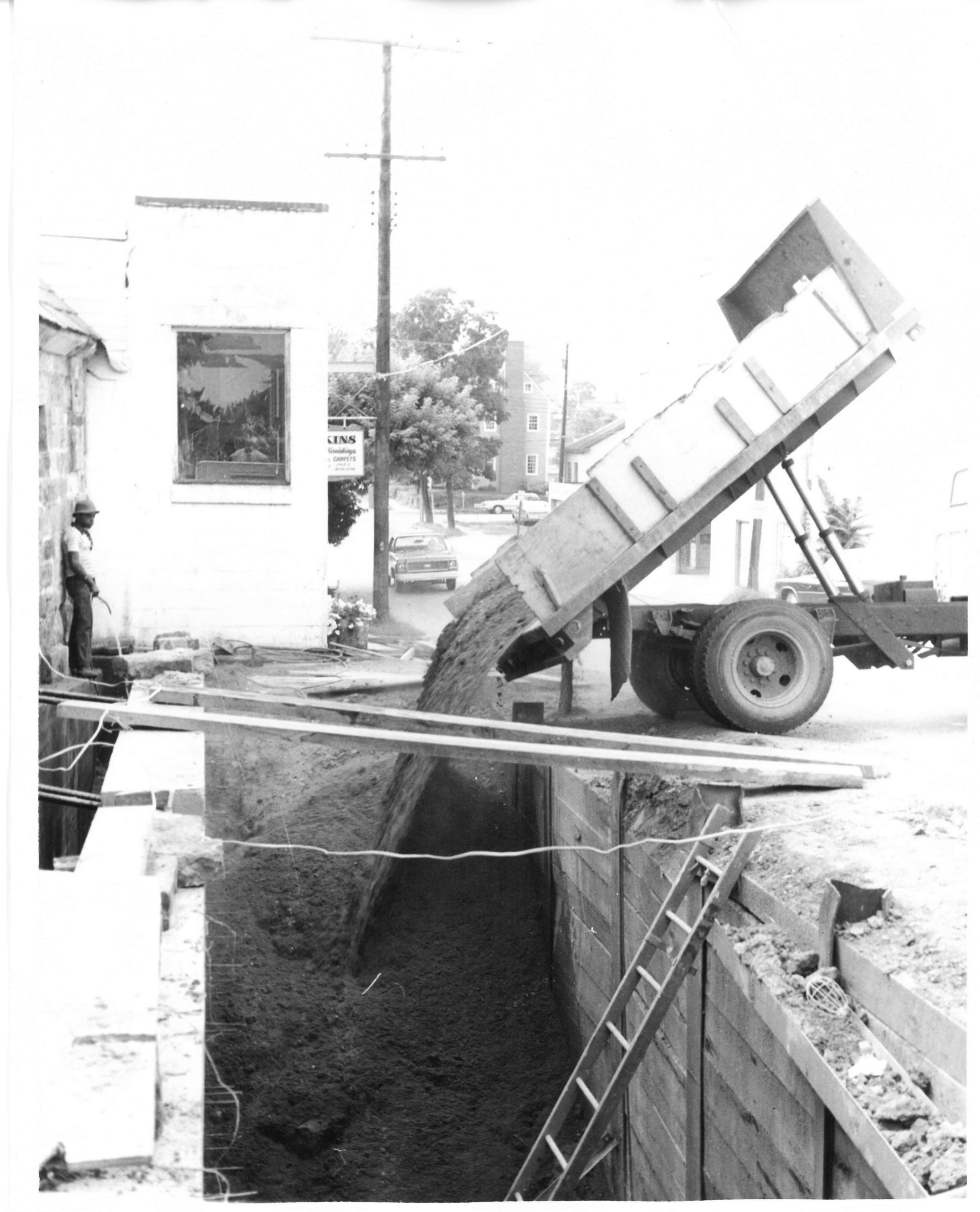
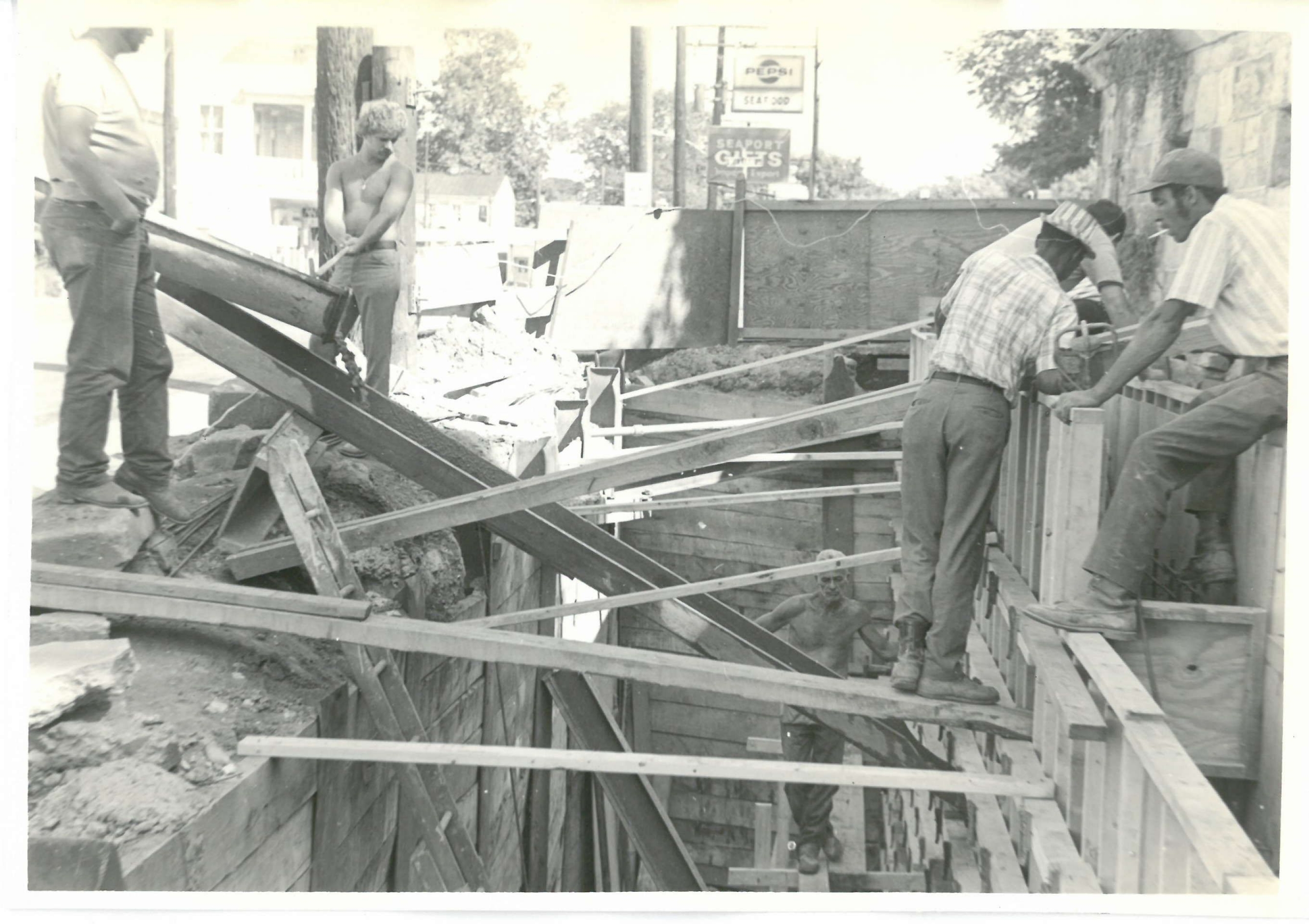
Circa-1975 image showing concrete for the subterranean retaining wall built to relieve pressure added to the warehouse’s west side during construction of Chatham Bridge in the mid-20th century.
6. What’s going on with the Old Stone Warehouse? For the last two years, HFFI has coordinated with City staff, adjoining property owners, historic tradespeople, area archaeologists, and UMW Preservation Department faculty, to explore the existing conditions, needed maintenance, and rehabilitation requirements for preserving and reopening the 1813 stone warehouse at 923 Sophia Street.
The building’s adaptive reuse must be sensitive to its historic fabric and architectural character, as its exterior and interior are protected by the state through a preservation easement. Yet it may be the City’s own regulations and codes that prove most challenging to getting water, sewer, and upgraded utilities into the warehouse. While progress and productive communication has been slow going, HFFI remains committed to assisting the City in planning for its proper repair and appropriate reuse.
Photos on file at HFFI archives.